


HOT PRODUCT | LOW STOCK
Montblanc 146 1955-1960, Black Celluloid GPT, #6 14C F Nib
Montblanc 146 1955-1960, Black Celluloid GPT, #6 14C F Nib
HM2602010
📒 History/Provenance
This is a mid-to-late 1950s production Montblanc 146, manufactured after Montblanc had settled the 146 into its mature form following the transitional 1952–1954 first run. Nibs from this window — sometimes called "later 1950s" factory grinds — are highly regarded by collectors for their exceptional softness and expressive character relative to their nominal grade. A factory Fine from this era does not write like a modern Fine; it writes closer to an EF in line width but with a springiness and responsiveness that modern nibs do not replicate.
Notably, this pen retains the early telescopic piston mechanism, placing it toward the earlier portion of this production window — likely 1955–1956 — before Montblanc fully standardized the simplified piston assembly across production. The telescopic mechanism is mechanically elegant and functions reliably when properly sealed, but it is the detail that separates the earliest 146s from all subsequent production.
The body shows honest wear consistent with decades of use: minor wear to the gold-plated trim and rear finial, and a degree of barrel transparency caused by celluloid thinning in high-contact areas. This is a natural aging process in celluloid material and does not affect structural integrity. The ink window remains fully transparent and the ebonite section is in excellent restored condition.
🧪 QA & Recommendation
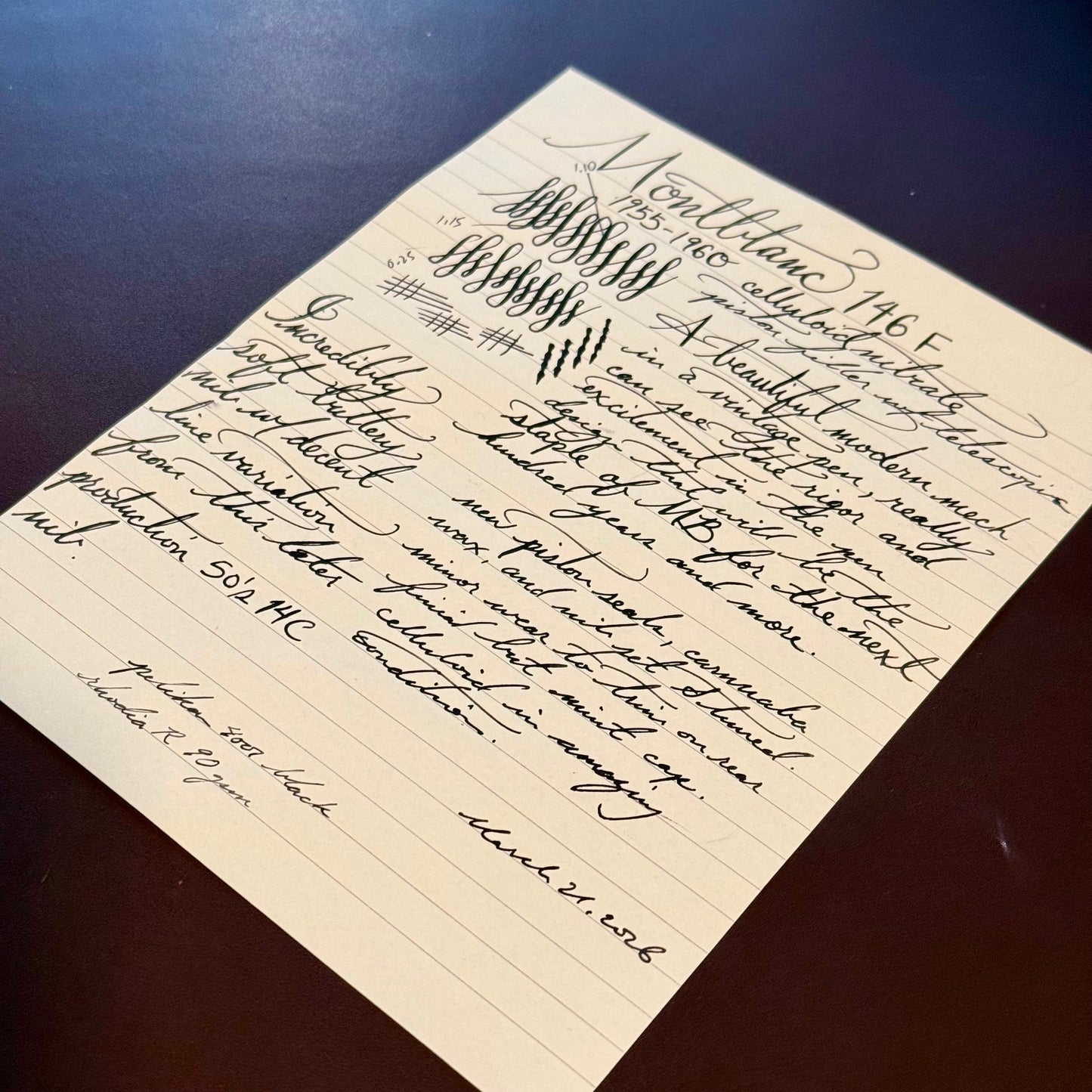
At 300g, this is a clean butter flex — soft enough to produce meaningful line variation with light intentional pressure, firm enough to write comfortably as a daily pen without babying. The hairlines are genuinely fine, almost EF territory, and the flex strokes land at a solid broad that adds real character to everyday handwriting without demanding calligraphic technique.
This nib rewards a relaxed grip. It does not need to be pushed — held at normal writing pressure it lays down a clean, consistent EF line; any additional intention in the downstroke immediately opens the tines toward 4B. Snapback is crisp with no hesitation. The flow is well-balanced for Pelikan 4001 and comparable inks, with no skipping or hard starting observed across extended writing sessions.
This is an ideal entry point into vintage 146 flex writing. The grade B condition reflects honest age and wear, not damage, and the nib performance is fully uncompromised. Recommended for daily writers, intermediate flex users, and anyone wanting a workhorse vintage Montblanc at a grounded price point.
Tested on Rhodia R 90 gsm with Pelikan 4001 Brilliant Black.
🔧 Restoration Commentary
Crisp model number and nib imprints on piston knob; minor wear to gold-plated trim and rear finial consistent with age.
Barrel shows light transparency at high-wear contact areas — inherent to aged celluloid, structurally sound.
Ink window fully transparent.
Black ebonite section rejuvenated and hand polished, "softness" of ebonite restored.
Coated with carnauba wax to shield from moisture, UV, and celluloid crystallization.
Pen fully disassembled and cleaned thoroughly, with new piston seals installed and lubricated.
Nib heat set and tuned for smoothness.

Technical Specifications

Technical Specifications
Brand: Montblanc
Model: 146
Production Year: 1955
Material: Black Celluloid Nitrate
Trim Color: Gold
Nib Size: 6
Nib Material: 14k gold
Nib Grind: F
Nib Flexibility: g
Line Variation: - (4.7x)
Pen Length: 134.34
Pen Grip Section:
Restorer: Heron's Mooncake
Restoration Grade: B
Couldn't load pickup availability
Montblanc 146 1955-1960, Black Celluloid GPT, #6 14C F Nib
Get it between - and -.


Appendix for Listing Details
Sweating the details is fundamental to understanding, appreciating, and knowing the peice of history you have in your hands.
All pens are filled and tested, not just dipped in ink, which does not reflect writing characteristics whatsoever.

Line Variation Standard
Different restorers have different standards for line sizing and especially for vintage pens, the printed tipping size will not always be accurate due to repairs/grinds/etc. Please use this as a frame of reference for consistency.

Flexibility Standard
Nib flexibility is such a controversial topic, but there needs to be some level of consistency so please take this table as a frame of reference for my restorations and as someone who is writing in a calligraphic/spencerian style of cursive script. Without objective measurements, flexibility terms such as wet noodle are useless as someone with stronger forearms and grip strength will make even manifold nibs into a wet noodle.

Restoration Ratings
These are guidelines incorporated from various online sources not limited to Reddit, David Nishimura, etc.
