


HOT PRODUCT | LOW STOCK
Pelikan 400, Tortoiseshell Celluloid Binde GPT, 14C Flex OM
Pelikan 400, Tortoiseshell Celluloid Binde GPT, 14C Flex OM
HM2602017
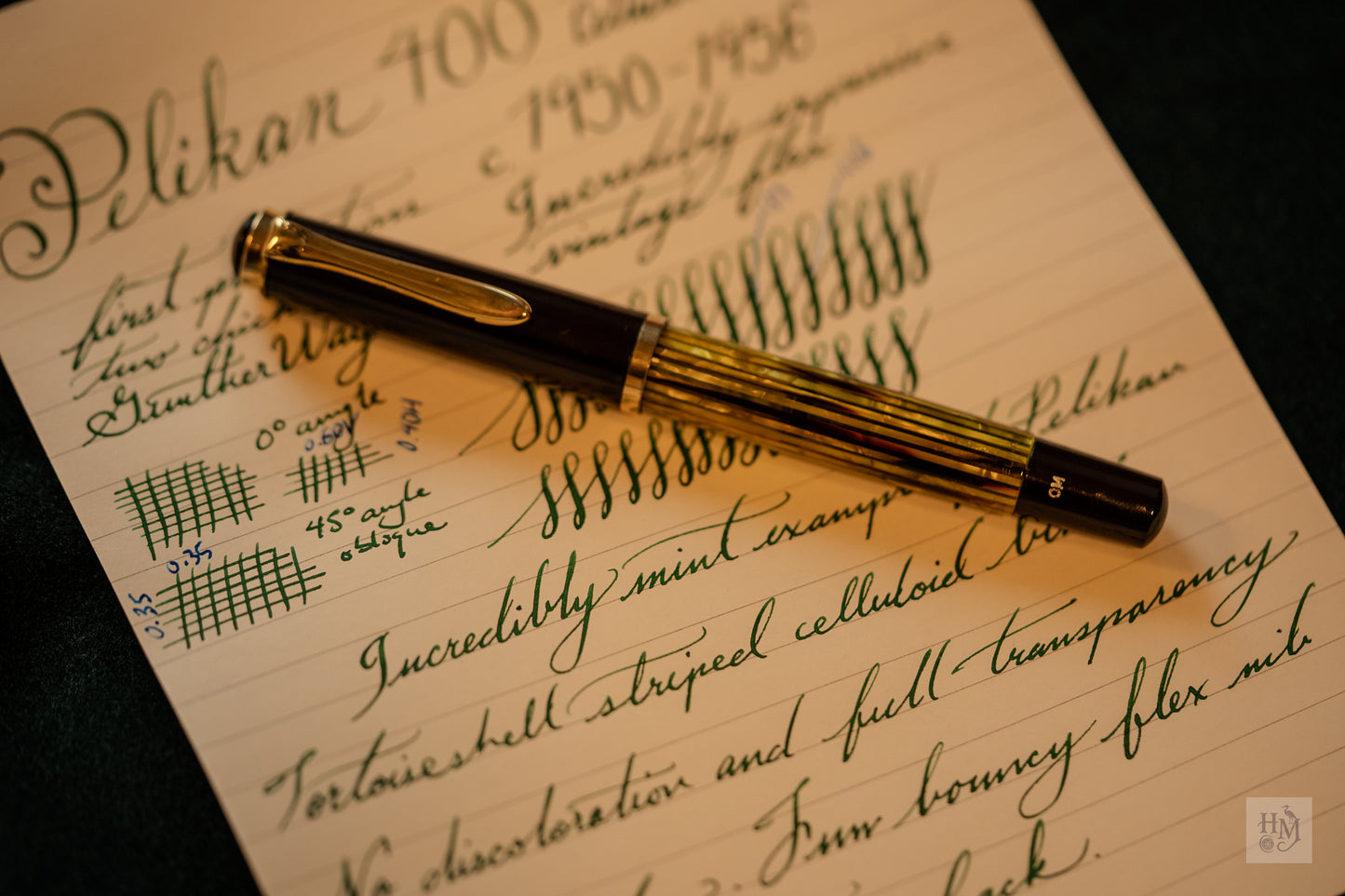
One of the earliest threaded-nib-unit Pelikan 400s — produced after Pelikan abandoned friction-fit units and before the 400N replaced the line in 1956. Dated 1950–1953 by the threaded nib unit, black piston seal, and unengraved cap band — Pelikan did not begin engraving cap bands until 1954.
The tortoiseshell binde on this pen is about as good as it gets. No fading, no crazing, no ambering — just warm honey-and-amber celluloid exactly as it looked when it left the factory. The "Günther Wagner Pelikan" stamping on the binde is exceptionally sharp, and the "OM" stamp on the piston knob is crisp and fully legible. Deep dark brown celluloid cap and finials with a gorgeous depth of color.
The nib is the real joy here. Bouncy, expressive vintage flex with perfect snapback — the kind of nib that makes you reach for a pen just to write one more line. Held at an oblique angle as intended, it delivers a consistent 0.35mm hairline in all directions. Rotate the pen to 90° against the paper and you unlock a beautifully sharp stub character: 0.40mm crossstrokes and 0.60mm downstrokes. Imprints sharp throughout with gold-plated trim in excellent condition.
Tested with Diamine Sherwood Green on Rhodia 90gsm.

Technical Specifications

Technical Specifications
Brand: Pelikan
Model: 400
Production Year: 1950
Material: Brown Celluloid Nitrate
Trim Color: Gold
Nib Size: 2
Nib Material: 14k
Nib Grind: F
Nib Flexibility: g
Line Variation: - (3.6x)
Pen Length: 125.59
Pen Grip Section:
Restorer: Heron's Mooncake
Restoration Grade: A
Couldn't load pickup availability
Pelikan 400, Tortoiseshell Celluloid Binde GPT, 14C Flex OM
Get it between - and -.


Appendix for Listing Details
Sweating the details is fundamental to understanding, appreciating, and knowing the peice of history you have in your hands.
All pens are filled and tested, not just dipped in ink, which does not reflect writing characteristics whatsoever.

Line Variation Standard
Different restorers have different standards for line sizing and especially for vintage pens, the printed tipping size will not always be accurate due to repairs/grinds/etc. Please use this as a frame of reference for consistency.

Flexibility Standard
Nib flexibility is such a controversial topic, but there needs to be some level of consistency so please take this table as a frame of reference for my restorations and as someone who is writing in a calligraphic/spencerian style of cursive script. Without objective measurements, flexibility terms such as wet noodle are useless as someone with stronger forearms and grip strength will make even manifold nibs into a wet noodle.

Restoration Ratings
These are guidelines incorporated from various online sources not limited to Reddit, David Nishimura, etc.
