


HOT PRODUCT | LOW STOCK
Excelsior Safety, Chased Black Ebonite, #2 18ct Flex
Excelsior Safety, Chased Black Ebonite, #2 18ct Flex
An export Excelsior, a Montblanc subbrand, that sports a Parisian 18ct flex nib (18ct was required in France under regulations on marketing gold products) and a pinned turning-knob mechanism. A very American-style mechanism, tested on subbrand pens to capture more of the market. A key benefit of these mechanisms was manufacturing simplicity: no holes need to be drilled into the ebonite for retention pins.
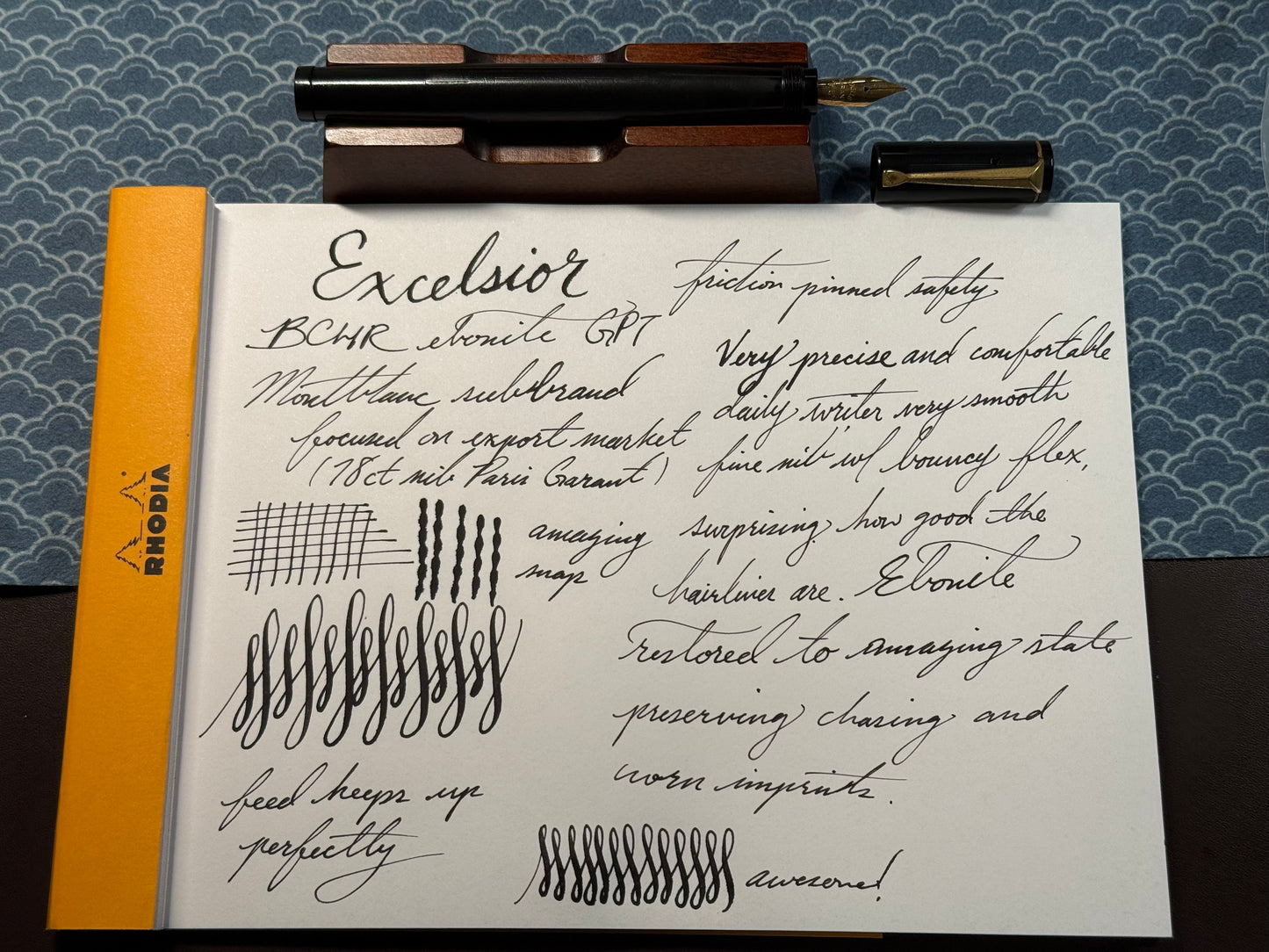
Brush flex nib that is a fantastic performer with sharp crisp hairlines and nice smooth flourished swells that easily reach 1.6mm. Very good snapback that brings the ink flow right back to transition into thin hairlines. Very precise and comfortable daily writer with a smooth bouncy EF nib.
Weakened hallmark imprints and chasing on the barrel, with great chasing on the cap. The friction-pinned turning knob was serviced with modern FKM O-rings and the knob action calibrated. Ebonite rejuvenated and lightly hand-polished, natural softness restored. Nib heat-set and tuned for flex and smoothness.
Tested on Rhodia 80gsm A5 pad with Pelikan 4001 Brilliant Black.

Technical Specifications

Technical Specifications
Brand: Montblanc
Model: 2 Safety
Production Year: 1920
Material: Black Ebonite
Trim Color: Gold
Nib Size: 2
Nib Material: 18k gold
Nib Grind: EF, Cursive Italic
Nib Flexibility: g
Line Variation: - (8.2x)
Pen Length: 119.77
Pen Grip Section:
Restorer: Heron's Mooncake
Restoration Grade: C+
Couldn't load pickup availability
Excelsior Safety, Chased Black Ebonite, #2 18ct Flex
Get it between - and -.


Appendix for Listing Details
Sweating the details is fundamental to understanding, appreciating, and knowing the peice of history you have in your hands.
All pens are filled and tested, not just dipped in ink, which does not reflect writing characteristics whatsoever.

Line Variation Standard
Different restorers have different standards for line sizing and especially for vintage pens, the printed tipping size will not always be accurate due to repairs/grinds/etc. Please use this as a frame of reference for consistency.

Flexibility Standard
Nib flexibility is such a controversial topic, but there needs to be some level of consistency so please take this table as a frame of reference for my restorations and as someone who is writing in a calligraphic/spencerian style of cursive script. Without objective measurements, flexibility terms such as wet noodle are useless as someone with stronger forearms and grip strength will make even manifold nibs into a wet noodle.

Restoration Ratings
These are guidelines incorporated from various online sources not limited to Reddit, David Nishimura, etc.
